October 26, 2026
Great visitor experiences start before visitors step through the door. Explore why clear pre-visit access and sensory information is now a baseline requirement for arts and heritage websites. Here’s how we put this into practice across venues in Bradford and beyond.
For many members of the public, visiting an exhibition is simple and requires little preparation. However, for people with a disability, the preparation for avisit often happen days or weeks earlier, on a smartphone or laptop screen.
Research consistently shows that disabled and neurodivergent audiences rely heavily on pre-visit digital information to plan a safe and comfortable trip. According to access charity, Euan’s Guide, 95% of disabled visitors look for access information before visiting somewhere new, and 85% check the venue’s website first.
When that information is missing, buried in a sub-menu, or locked inside an inaccessible PDF, the message to prospective visitors is clear: this space wasn’t designed with you in mind.
The Pre-Visit Information Gap
Across the arts and heritage sector, digital access information has lagged behind physical improvements. While UK museums have become much better at listing Blue Badge parking and assistance dog policies, support for neurodivergent, D/deaf, and blind visitors remains scarce.
- A 91% gap in visual stories: The Heritage Access 2022 audit found that while 19% of UK museums and heritage sites offered no online access information at all, 91% lacked visual stories to help visitors prepare for unfamiliar spaces.
- Sensory unpredictability keeps audiences away: A 2025 international study in Archnet-IJAR revealed that nearly half of neurodivergent respondents avoid museums and galleries due to sensory overload or underload. Meanwhile, research by engineering firm, Buro Happold, found that over 50% of neurodivergent people find sensory maps genuinely helpful when navigating museums and galleries.
- Inconsistency erodes trust: the Attitude is Everythings November 2026 State of Access Report found that 67% of disabled audience members experience access provisions as inconsistent, driving 58% to be prevented from attending events altogether.
At the same time, legal and sector expectations are catching up. Between the UK’s Public Sector Bodies Accessibility Regulations (WCAG 2.2 AA), the Equality Act 2010, and the rollout of Arts Council England’s All In standards across the UK and Ireland in 2027, clear digital access communication is now a baseline requirement.
What Good Digital Access UX Looks Like
Designing an inclusive cultural website means treating access and sensory information as core visitor infrastructure, not an afterthought. In our agency’s baseline UX framework, that comes down to four practical principles:
- Elevate access to primary navigation: “Plan Your Visit” and “Access” belong in the main header and persistent footer andnever hidden three clicks deep.
- Design for predictability with visual stories: step-by-step photo guides showing the entrance, reception desk, galleries, and toilets remove the anxiety of the unknown before a visitor leaves home.
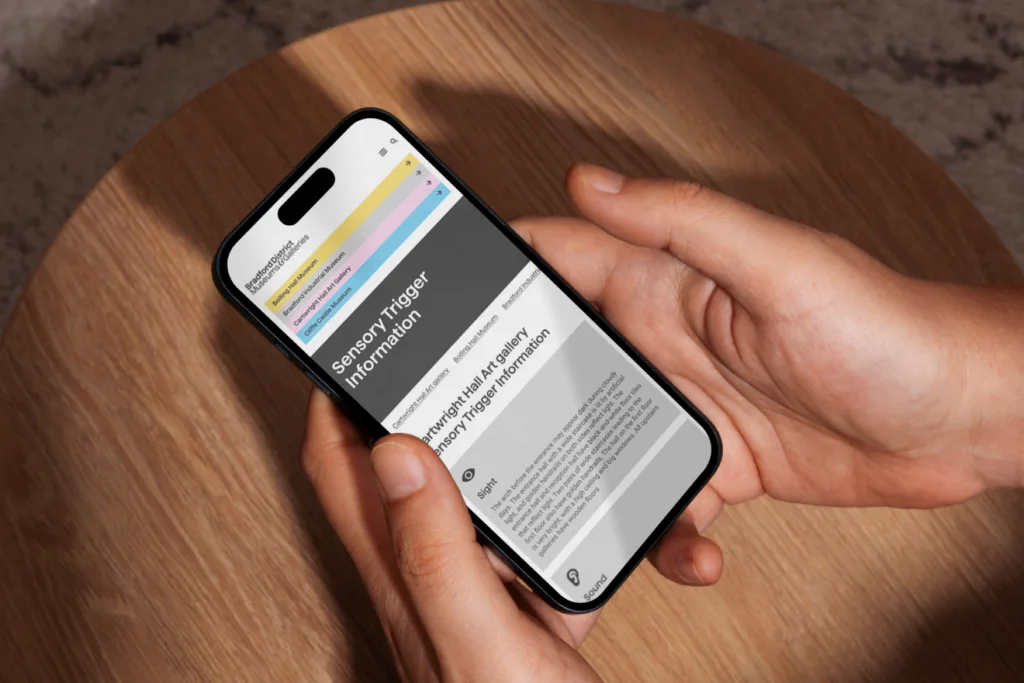
- Map sensory triggers honestly: rather than relying on colour-coded icons alone, effective sensory maps pair clear symbols with plain-English descriptions of bright lighting, echoing acoustics, interactive soundscapes, sudden noises (like hand dryers), and designated quiet spaces.
- Remove phone-only bottlenecks: if general visitors can book tickets or parking online, disabled visitors should be able to book wheelchair spaces, companion tickets, and mobility aids in the exact same digital flow.
Case Study Spotlight: Bradford District Museums & Galleries
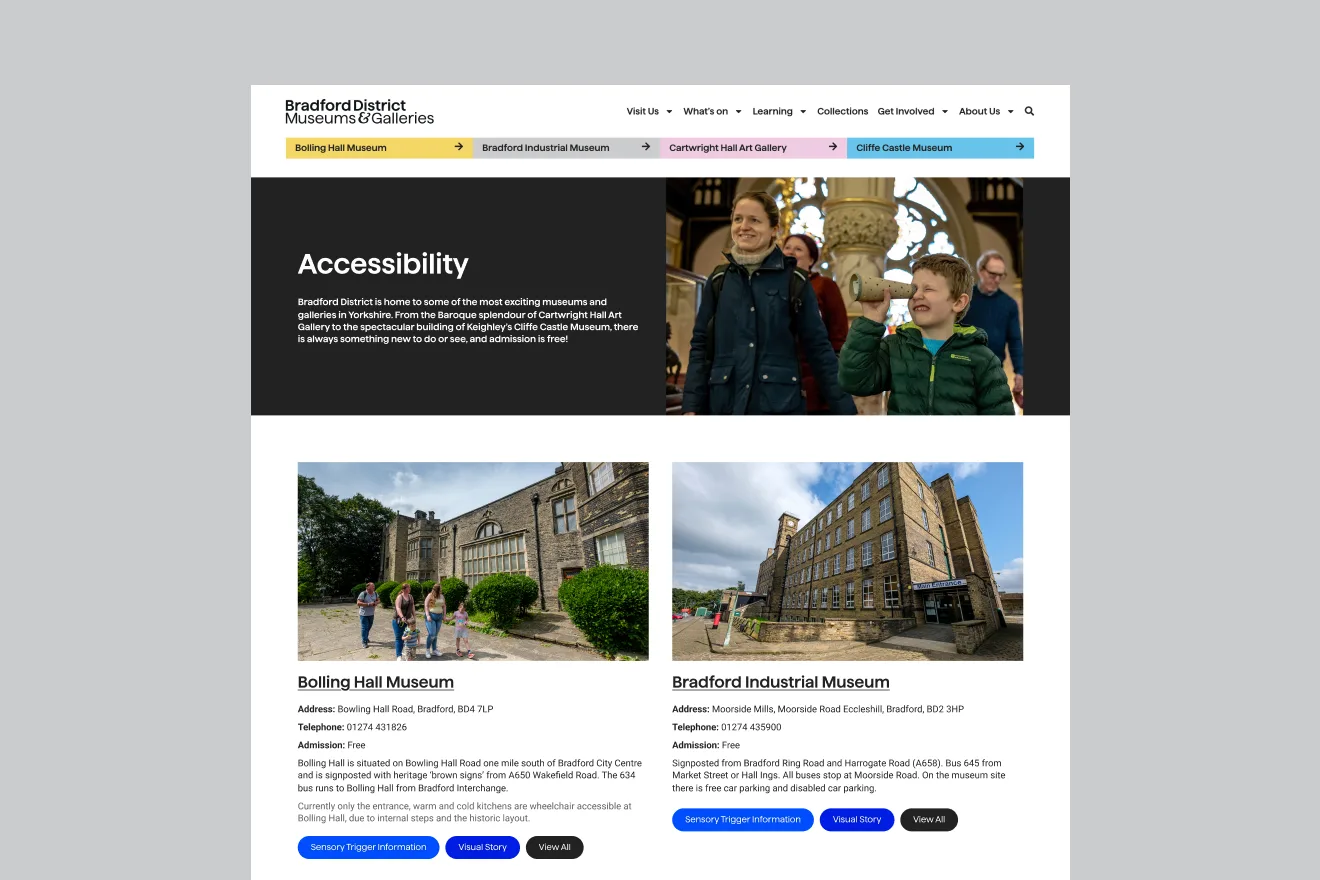
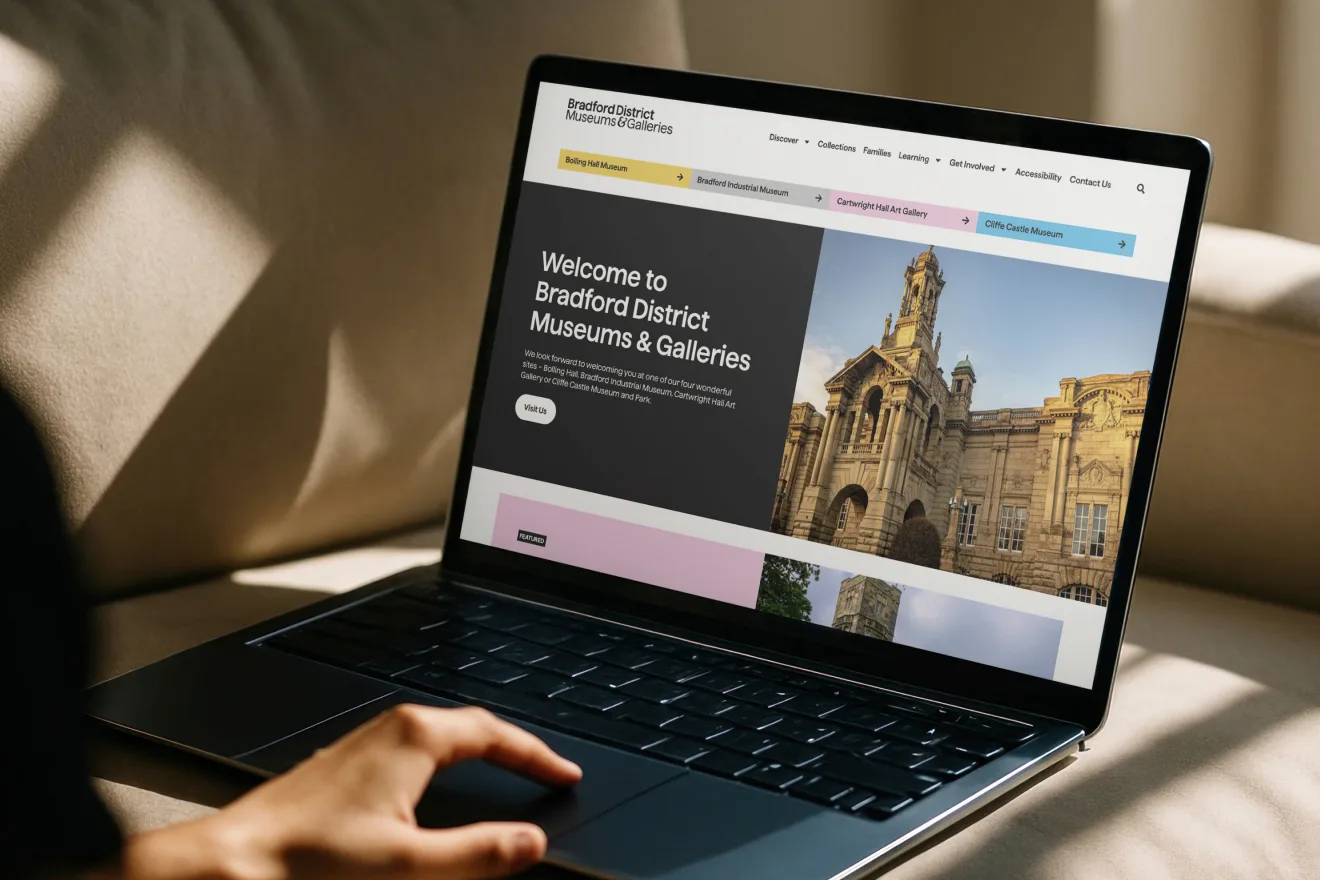
We recently partnered with Bradford District Museums & Galleries to overhaul how access and sensory information is structured and presented across their digital estate, covering all four of their distinct sites: Cartwright Hall Art Gallery, Bradford Industrial Museum, Bolling Hall Museum, and Cliffe Castle Museum.
Each venue presents a wildly different physical and sensory environment, from the grand Victorian galleries of Cartwright Hall and the working machinery of the Industrial Museum to the historic, atmospheric interiors of Bolling Hall. A one-size-fits-all access statement simply wouldn’t work.
What we delivered:
- Site-by-site access hubs: we restructured the digital architecture so every venue has a dedicated, easy-to-find access hub bringing together all key pre-visit essentials in one place, including opening times, public transport directions, accessible parking, step-free routes, and lift dimensions.
- Accessible visual story integration: rather than leaving visual stories buried in hard-to-find downloads, we made sure each venue’s visual guide was prominent and accessible directly on dedicated accessibility pages,showing visitors what to expect from arrival to exit before they travel.
- Sensory trigger mapping: working alongside museum teams, we catalogued venue-specific sensory considerations, from sight, sound, smell and touch, translating them into scannable, WCAG 2.2 AA-compliant web pages.
- Editor-friendly CMS guardrails: we built structured templates inside their CMS so curatorial and visitor-experience staff can easily update sensory alerts whenever temporary exhibitions or noisy installations change.
👉 Read the full Bradford District Museums & Galleries Case Study
Ready to Make Inclusion Your Digital Baseline?
Whether your institution is preparing for All In accreditation, modernising a legacy website, or auditing your ticketing and pre-visit journeys against WCAG 2.2 AA, our team can help you build an experience that welcomes every visitor before they even step inside.
Get in touch to book an Access & UX Discovery Audit
Sources
95% of disabled visitors look for access information before visiting somewhere new, and 85% check the venue’s website first.
- Source: Euan’s Guide survey data, cited in VocalEyes’ State of Museum Access 2018: Does your museum website welcome and inform disabled visitors?
- Link: VocalEyes, State of Museum Access 2018 (ResearchGate)
19% of UK museums and heritage sites offered no online access information at all, and 91% lacked visual stories (up only from 2% to 9% between 2018 and 2022).
- Source: VocalEyes, Stagetext, Autism in Museums, and Centre for Accessible Environments, Heritage Access 2022
- Links: CultureHive, Heritage Access 2022 Report | National Lottery Heritage Fund Summary
Nearly half of neurodivergent respondents avoid museums and galleries due to sensory overload or underload.
- Source: Granland, Sadia & Cooper (2025), Beyond the Minimum: Designing for Neurodiversity in Museums and Galleries, published in Archnet-IJAR (survey of 281 neurodivergent participants across 23 countries)
- Link: Buro Happold / Archnet-IJAR 2025 Study (PDF)
Over 50% of neurodivergent people find sensory maps genuinely helpful in museums, galleries, and festival settings.
- Source: Buro Happold (March 2026), Sensory Mapping: The design and use of sensory maps for the built environment
- Link: Buro Happold, Sensory Mapping Report 2026 (PDF)
67% of disabled audience members experience access provisions as inconsistent, and 58% have been prevented from attending events altogether.
- Source: Attitude is Everything (November 2026), State of Access Report 2026
- Links: Attitude is Everything, State of Access Report 2026 | Direct Report PDF